
Splits and Steel: The Rise of the Stretching Machine for Martial Artists
In the 1980s, a wave of devices hit the market promising to improve one’s flexibility. Among them was a contraption that became legendary in martial arts circles: the Hurley Stretch Rack. This “bad boy,” as it was often called, was practically homemade in appearance — assembled from metal, pinewood, and cables. Its simple but effective design allowed users to crank their way into deeper stretches, pushing their flexibility further than floor work alone could. What started with this rugged piece of equipment quickly grew into a niche industry, as many other stretch machines followed in its path.

The Hurley Stretch Rack set the tone for what these devices would become: functional, sometimes intimidating, and always attention-grabbing. Sitting on the padded seat, the practitioner placed their legs along support bars and turned a crank to gradually force the legs apart, simulating a split. The pinewood frame gave it a raw, almost garage-invented feel, but that authenticity resonated with martial artists who valued grit as much as technique. Later models refined the design with sturdier metals, smoother pulley systems, and more comfortable padding — but the essence of controlled, mechanical stretching remained the same.
Later variants like the Gladiator Stretch Machine took the market and emphasized durability and catered to competitors

Black Belt Magazine Publisher and World Champion Cynthia Rothrock cashed in on the craze endorsing the short lived Gladiator.

By the 1990s, stretching machines had become a recognizable part of martial arts and fitness culture. Machines like the VersaFlex made the concept more accessible to everyday users. These machines promised something floor stretches often lacked: measurable progress. Each crank could take the user slightly further, offering both a challenge and a sense of accomplishment. They were marketed in martial arts magazines, fitness catalogs, and even late-night infomercials, becoming both a training tool and a status symbol in some home gyms.

Though stretch racks are no longer as common in today’s fitness spaces — replaced by yoga, mobility programs, and resistance-based methods — they remain iconic symbols of martial arts training in the late 20th century.
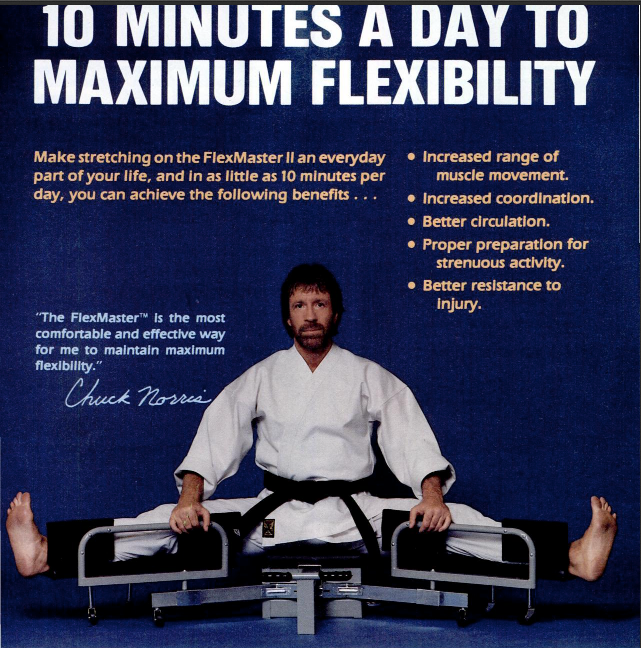
Collectors and practitioners still seek out old models, and some modern companies continue to manufacture updated versions for a niche audience. For many, these machines are more than just equipment; they represent a bygone era when mechanical ingenuity, martial ambition, and a bit of bravado came together to push the limits of flexibility.

Century Martial still carries the machine in a redefined form now branded as Versaflex 2.0. Long live the splits!


